Unraveling: Why aren't innovative cars (conceptual or prototype) actually manufactured?

Every now and then, you may come across certain cars – or just pictures of them – that look different from anything you see on the road. It doesn't seem at all that she will one day escape from behind velvet ropes and security measures at exhibitions to be able to get to the road.
Show key points
- Innovative cars are experimental creations designed to explore new technologies, designs, and concepts without the constraints of traditional manufacturing standards.
- Automakers use these vehicles to test and validate engineering theories, design elements, and futuristic technologies in a tangible form.
- While they serve as impressive marketing tools at exhibitions, most innovative cars are never built with public road use in mind due to safety and legal regulations.
- ADVERTISEMENT
- High development and manufacturing costs make it impractical to mass-produce these vehicles, especially when the features may not appeal to average customers.
- Many innovative car designs prioritize creativity and experimentation over practicality or customer needs, limiting their commercial viability.
- Once their purpose is fulfilled, these cars are often dismantled, preserved, or sold under strict conditions to prevent road use.
- Despite being forward-looking, the relevance of innovative cars diminishes over time as design trends and customer expectations evolve.
These exciting vehicles, also known as innovative cars, evade all our desperate and desperate longing for innovation, being forgotten year after year. Why does it exist in the first place? And if they make it, why don't we see it on the road? Fasten your seatbelt, because we're about to find out!
Why do manufacturers build early cars?

Before we dive into why innovative cars don't make it to the road, it's important to understand what they represent. Innovative cars may or may not be prototypes that lead to the creation of production units. Depending on how well you think about them, they can be either sketch experiments, or real-life models. From computer displays and graphics, to clay or wax models, to scale models and life-size vehicles, innovative cars cover the entire spectrum.
Recommend
Here's a fun fact – most innovative cars never see the light of day. Very few of them were built with the aim of preserving it, and even then, they are not fully operational. However, automakers make great efforts to manufacture them, often spending significant resources in the process. Here's why.
Proof of concept
It's not enough for a car to look great on paper; it must live up to its purpose in real life. Innovative cars are the best way to prove (or refuse) theories related to design and engineering.
It serves as a great testing platform for employing new technologies, design languages, features, materials, and other things.
Design Superiority

Innovative cars are often developed with large budgets and convenient schedules. Beyond the usual optimization, trade-offs and cost reductions, it provides manufacturers with a space to innovate and explore their full potential.
At trade shows and auto shows, they also serve as great marketing tools, showcasing the manufacturer's ingenuity in various aspects of the automotive industry.
Insight into the future

While obscene concepts are important for earning boasting rights, they often reflect a manufacturer's interpretation of the future. The features, engineering, and designs on display in innovative cars may find their place to some extent in newer models and models.
Why, then, aren't innovative cars made?
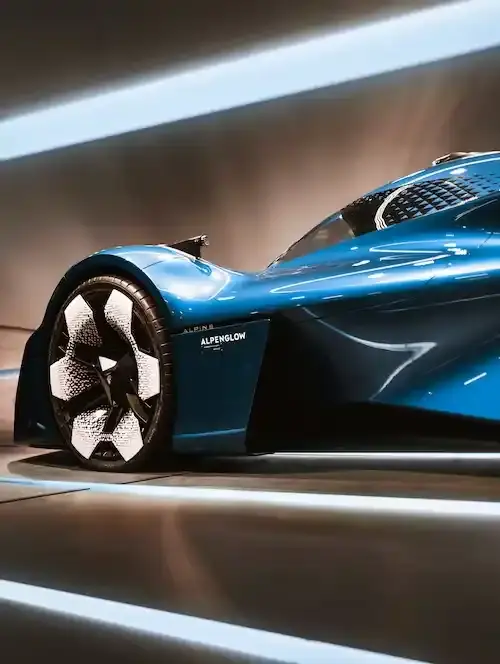
All vehicles using public roads must adhere to certain rules. These rules are intended to ensure the safety of passengers as well as strangers. Some of these rules include:
Reduce the energy provided by the engine to reduce accidents.
Avoid using items designed with a sharp body that increase the risk of injury to at-risk road users.
Presence of breakdown zones (for safety during impact accidents) and other safety features that require special space.
Because innovative cars are designed with a great deal of freedom, you may avoid some or more of these rules. As a result, they are not suitable for public roads and, therefore, for mass production.
Large-scale manufacturing cost

The features included in innovative cars can be quite ahead of their time, or even expensive. If they were put into production, it would increase their prices, making them less attractive to customers. For example, an innovative car with a premium audio system or a head-up display may not be relevant to producing a car aimed at the average customer. Including such features can drive up costs, negatively impacting sales.
Design futility

Production vehicles are designed to fit the widest possible segment, both aesthetically and functionally. On the other hand, innovative cars are not necessarily manufactured with the buyer in mind. While creating such cars can be a great engineering or design exercise, it carries little benefit for traditional customers.
Take, for example, a car made of foreign materials that lead to leather-like wrinkles when opening doors. Or maybe there is a car with strategically placed foam pads instead of seats to reduce weight. Moreover, some cars may feature fully functional aircraft engines as a demonstration of engineering prowess.
While these models push the boundaries of materials science and engineering, they add little value to the lives of potential customers. Sometimes, a potentially useful technology can be a bit premature, and it may lose its relevance to some customers.
What happens to innovative cars at the end of their lives?
After achieving the purpose of an innovative car, it usually undergoes one of the following actions:
Total dismantling/destruction of the protection of the Organization's intellectual property.
Preservation at the manufacturer's facility for marketing and legacy purposes.
Sales to museums or private collectors, with complex standards to prevent their registration for use on public roads.
Apart from being unavailable for reuse, there is another drawback of innovative cars. While it may seem very futuristic when your eye first falls on it, novelty fades over time.
Time pardons design over time. Thus, innovative cars lose their relevance over time; what looks like a future at some point is not necessarily in vogue in the future. Automakers should focus on what customers want rather than their own preferences. However, innovative cars are usually designed with a decade into the future.
Innovative cars are a great way to let customers know what they might want in the future. Most importantly, it's about showing customers buyers things they don't even know they want!