Rosetta Stone: How the Ancient Egyptian Hieroglyphic Alphabet Was Deciphered by Champollion
Show key points
- The Rosetta Stone, discovered in Egypt in 1799, played a vital role in deciphering ancient Egyptian writing because it contained the same text in hieroglyphics, demotic, and ancient Greek.
- Jean-François Champollion, recognized as the father of Egyptology, was the first to fully decode Egyptian hieroglyphs using the clues provided by the Rosetta Stone.
- Hieroglyphics, the formal writing system of ancient Egypt, included phonetic symbols, logograms, and determinatives to convey both sound and meaning.
- ADVERTISEMENT
- The inscription on the Rosetta Stone is a decree from 196 BC issued to honor Ptolemy V, designed to be displayed in temples across Egypt in multiple languages for broader comprehension.
- Although British scholar Thomas Young made initial progress, it was Champollion who realized hieroglyphs combined phonetic and ideographic elements, revolutionizing their interpretation.
- After being transported to England in 1802, the Rosetta Stone has been housed in the British Museum and remains one of its most iconic and studied artifacts.
- The successful decipherment of hieroglyphs not only provided insights into ancient Egyptian civilization but also laid the groundwork for the modern field of Egyptology.
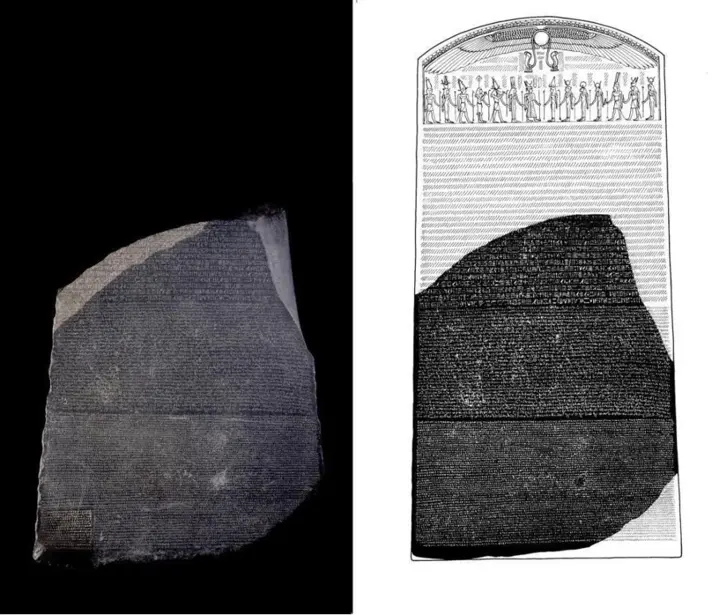
The Rosetta Stone, discovered in 1799 near the city of Rosetta in Egypt's Nile Delta, is part of a larger tablet inscribed with a decree issued in 196 BC during the Ptolemaic dynasty. The decree was written in three scripts: hieroglyphic, demotic (an abbreviated form of hieroglyphic), and ancient Greek, so that it could be read and understood by Egypt’s diverse population. The stone was carved during the Hellenistic period and is believed to have originally been displayed inside a temple.
The Rosetta Stone is an irregularly shaped slab of black granite, 3 feet 9 inches (114 cm) long and 2 feet 4.5 inches (72 cm) wide, broken in antiquity. It contains 14 lines of hieroglyphs, 32 lines of demotic script, and 54 lines of ancient Greek. The stone was found by a Frenchman named Bouchard or Bousard in August 1799.
Recommend
Hieroglyphic alphabet: a closer look
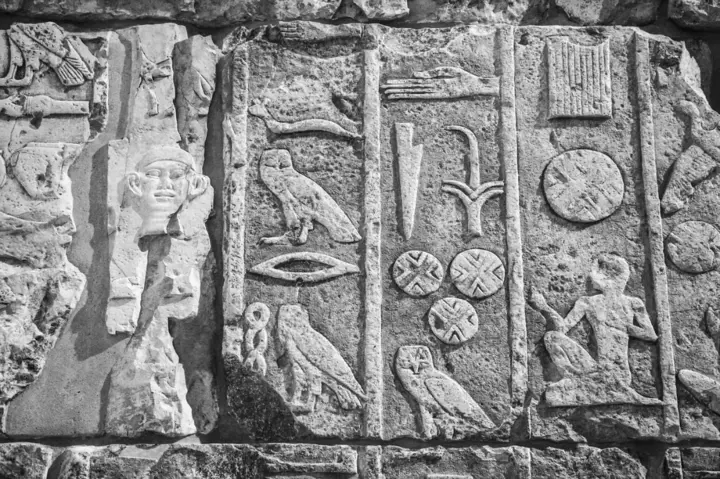
The hieroglyphic writing system used by the ancient Egyptians is both fascinating and complex. It emerged in Egypt around 3200 BC and remained in use until Rome annexed the country. Writing in ancient Egypt was elaborate and labor-intensive.
Hieroglyphs include three main types of signs. The first is phonetic signs, which include single signs that function like letters of an alphabet. These roughly correspond to the 26 letters of the English alphabet. Egyptian also has signs for the sounds "sh" (as in "ship") and "ch" (as in "chip" or "charlie").
The second type is logograms, characters that represent whole words, much like Chinese characters. These are the basic symbols used by the Egyptians in their writings, though many other signs also appear.
The third type is determinatives, symbols that provide additional information about the meaning of a word. For example, a man determinative can be added to a word to show that it refers to a male.
Only about three percent of ancient Egyptians could read hieroglyphs. The signs are pictorial representations of sounds and ideas. They were carved on buildings and tombs, and scholars believe the Egyptians began developing this system around 3000 BC.
Hieroglyphs are written in rows or columns and can be read from left to right or from right to left. You can tell the direction of reading because human and animal figures always face the start of the line.
Jean-François Champollion: Father of Egyptology
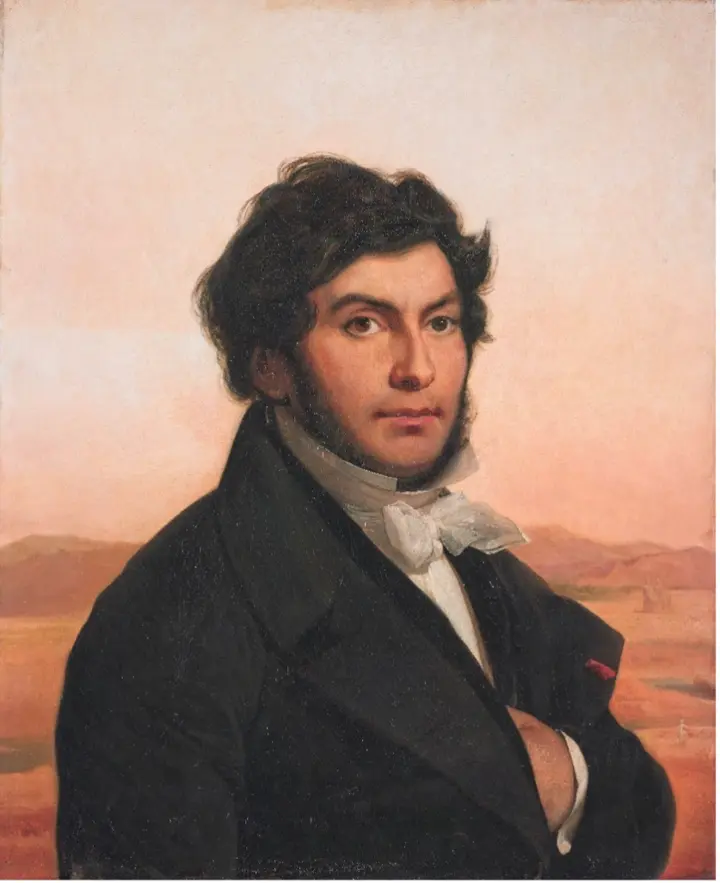
Jean-François Champollion, born on December 23, 1790 in Figeac, France, was a French philologist and orientalist best known for deciphering Egyptian hieroglyphs and for founding the field of Egyptology.
Champollion was a child prodigy in languages, presenting his first major research on the demotic script in his late teens. As a young scholar he gained a reputation in scientific circles and mastered Coptic, Ancient Greek, Latin, Hebrew, and Arabic.
In the early nineteenth century French culture experienced a wave of fascination with Egyptology, sparked by Napoleon’s campaign in Egypt (1798–1801), which also brought the trilingual Rosetta Stone to public attention. Scholars debated the age of Egyptian civilization and the nature and function of hieroglyphs.
In 1820 Champollion set out in earnest to decipher hieroglyphs, soon surpassing the earlier work of the British scientist Thomas Young, who had made the first breakthrough before 1819. In 1822 Champollion published his landmark findings: the Rosetta inscriptions showed that the Egyptian writing system combined phonetic and ideographic signs.
Champollion’s career unfolded amid political turmoil in France that frequently disrupted his research. His behavior could be impulsive at times, which did not always help his cause, but his connections with influential scholars such as Joseph Fourier and Silvestre de Sacy supported his work. At times he felt exiled from parts of the scientific community.
He became curator of the Egyptian collection at the Louvre in 1826, led an archaeological expedition to Egypt in 1828, and from 1831 headed the newly created chair of Egyptian antiquities at the Collège de France. His major publications include an introduction to the hieroglyphic system (1824), a grammar of Egyptian (1836–1841), and a dictionary (1841–1843), as well as a partly completed work on the Egyptian pantheon (1823–1825).
Champollion’s work laid the foundations of Egyptology and opened the way to a deeper understanding of ancient Egypt’s rich history and culture.
Deciphering the Ancient Egyptian Hieroglyphic Alphabet: Champollion's Discovery
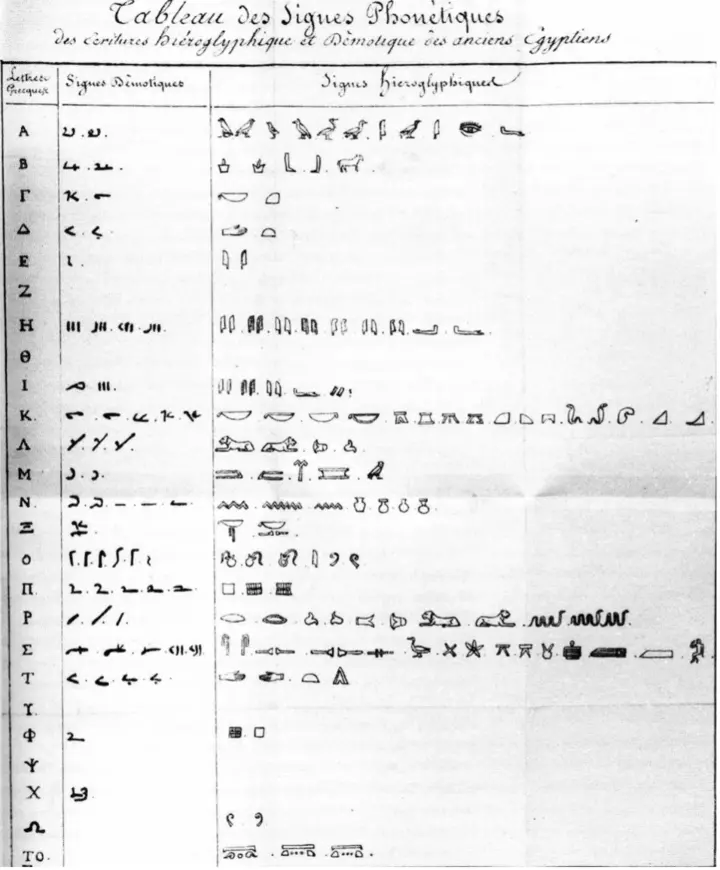
Champollion’s decipherment of Egyptian hieroglyphs is one of the field’s landmark achievements. The process was complex and demanded a deep knowledge of several scripts and languages.
His work built on the progress made by Thomas Young, who had advanced understanding of demotic script and identified many phonetic signs. Young, however, thought phonetic hieroglyphs were used only for foreign words.
Champollion realized that hieroglyphs combined phonetic and ideographic elements. That insight was the key breakthrough. By comparing the hieroglyphs in the cartouche for Ptolemy with other inscriptions, he saw that the same signs could represent the names of different foreign rulers.
In the early 1820s Champollion published studies on hieratic and hieroglyphic writing based on his work with the Rosetta Stone. He compiled a comprehensive list of signs and their Greek equivalents. His claims met with skepticism at first and accusations that he had borrowed ideas from Young without adequate credit, but his findings gradually won acceptance.
Champollion went on to determine the values of most phonetic hieroglyphs and to establish many grammatical rules and a growing vocabulary for ancient Egyptian. His work set the basis for modern Egyptology and unlocked access to Egypt’s written heritage.
What does the inscription actually say?
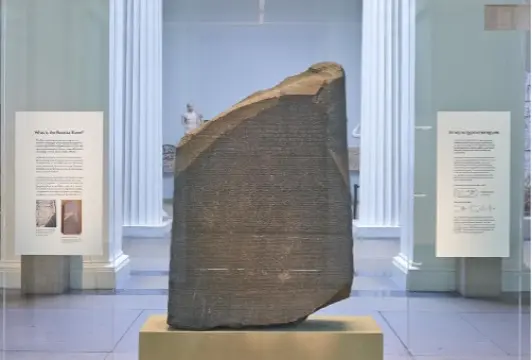
The inscription on the Rosetta Stone is a decree issued by the council of priests. It is one of a series that confirms the royal cult of the 13-year-old Ptolemy V on the first anniversary of his coronation in 196 BC. You can read the full translation here (opens in a new window).
According to the stone’s text, an identical copy of the decree was to be placed in every major temple throughout Egypt. Whether that was followed everywhere is unclear, but copies of the same trilingual decree have been found and are now displayed in other museums. The Rosetta Stone is therefore one of many mass-produced inscriptions intended to disseminate a decree issued by the council of priests in 196 BC. In fact, the text on the stone is a copy of a prototype composed about a century earlier in the third century BC—only the date and names were changed.
Where is it now?
After the stone was shipped to England in February 1802, it was presented to the British Museum by King George III in July of that year. Initially the Rosetta Stone and other sculptures were placed in temporary structures on the museum grounds because the floors could not yet bear their weight. After trustees petitioned Parliament for funds, a new gallery was built to house these objects.
The Rosetta Stone has been on display at the British Museum since 1802, except for one break. Near the end of World War I, in 1917, when the museum feared heavy bombing in London, it was moved to safety along with other important portable objects. The stone spent the next two years at a postal railway station 50 feet below the surface of Holborn.
Between October 13, 2022 and February 19, 2023, the Rosetta Stone was shown alongside other objects that helped scholars decipher hieroglyphs in the special exhibition "Hieroglyphics: The Conquest of Ancient Egypt." You can also touch a replica of the Rosetta Stone in Room 1 (Enlightenment Gallery) and view it remotely on Google Street View.
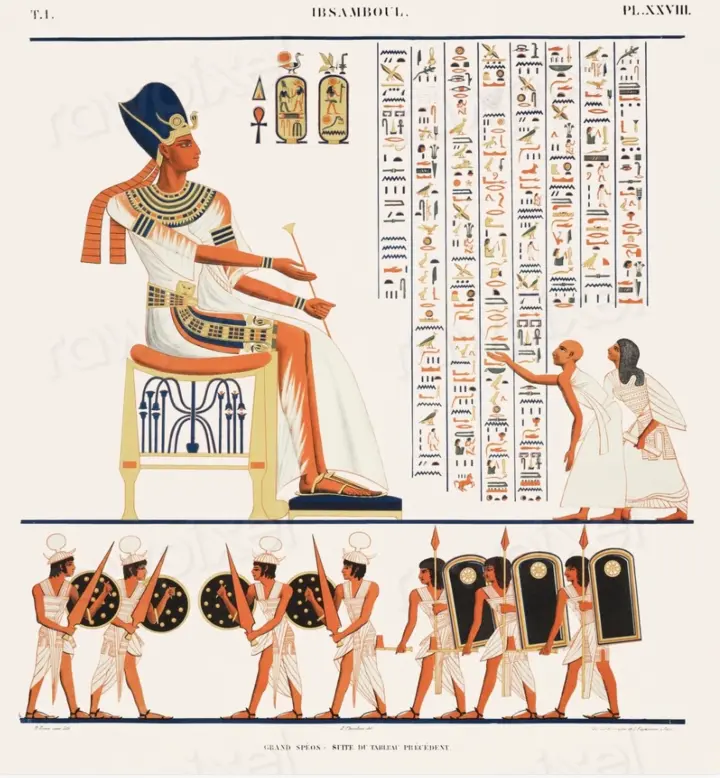
Champollion’s decipherment of Egyptian hieroglyphs, aided by the Rosetta Stone, marked a turning point in the study of ancient civilizations. He not only unlocked the secrets of ancient Egypt but also paved the way for further study of other ancient texts. Today, thanks to Champollion’s work and the discovery of the Rosetta Stone, we can appreciate the richness and complexity of ancient Egyptian civilization in a way that was impossible for more than a thousand years.