Five fascinating facts about white whale will surprise you.

Aquatic animals are among the most charming and mysterious creatures in our vast marine world. One especially remarkable animal to get to know up close is the white whale. It is a wondrous creature with many surprising facts that will captivate you.
Show key points
- The white whale, also known as the beluga, is easily recognizable by its unique white color, rounded head, lack of a dorsal fin, and freely movable neck.
- Its ability to dive up to 600 meters and remain underwater for over 90 minutes highlights the beluga’s physical strength and endurance.
- Belugas are intelligent and social creatures, using advanced vocal communication and even mimicking human speech to interact with their environment and humans.
- ADVERTISEMENT
- This species inhabits Arctic and sub-Arctic regions, exhibits seasonal migrations, and shows playful behaviors by interacting with natural objects like seaweed and stones.
- Belugas undergo seasonal molting to maintain their bright white appearance, often rubbing against riverbeds or stones to shed their old skin.
- As a symbol of marine conservation, the beluga’s decreasing population due to climate change, hunting, and pollution emphasizes the urgency of protecting marine ecosystems.
- The legendary tale of Moby Dick and historical observations like Jacques Cartier's encounter with singing belugas underline their cultural and scientific significance throughout history.
1. Did you know? White whale is...
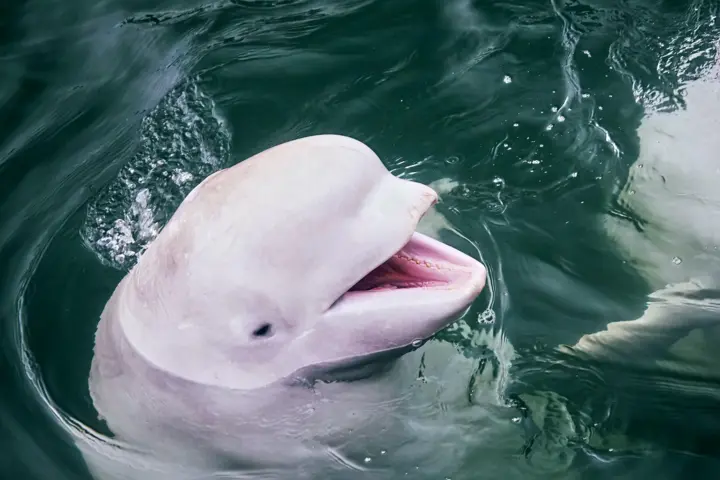
The white whale is one of the most mysterious and attractive sea creatures in the world of marine life. Have you ever thought about learning more about this remarkable animal and what makes it special? Now is the time to discover surprising facts you may not know about the white whale.
White whales have a thick body, a white or yellowish color, a rounded head, a short beak and no dorsal fin. Fully mature belugas develop a distinctive white hue; the head becomes smaller with an apparent forehead ridge and visible folds behind the blowhole.
Recommend
The surface of the body is often marked with scars, and there may be fatty folds and creases. A dorsal ridge replaces the dorsal fin and sits in the middle and toward the rear of the back. The trailing edge of the tail fluke may be dark brown with a pronounced central notch, and the protrusion of the caudal lobe becomes more noticeable with age. The neck can move freely, allowing the whale to gesture and rotate its head. The pectoral fins are broad and spatulate, flexible in movement, and the lip line is wide. Male pectoral fins curve upward and become more pronounced with age. The skin on most of the body is coarse. The white skin of adult whales sometimes takes on a slight yellowish tinge during the summer estrus period but it fades after molting. Body color changes with age: from dark gray at birth to gray, light gray and a bluish-tinted white; when belugas reach sexual maturity at five to ten years, they become pure white. The dorsal ridge and the edges of the pectoral and caudal fins remain dark throughout life.
Newborn whales measure about 1.5 to 1.6 meters in length and weigh around 80 kilograms. Adults are roughly 3 to 5 meters long and weigh between 0.4 and 1.5 tons.
2. What makes a white whale special?
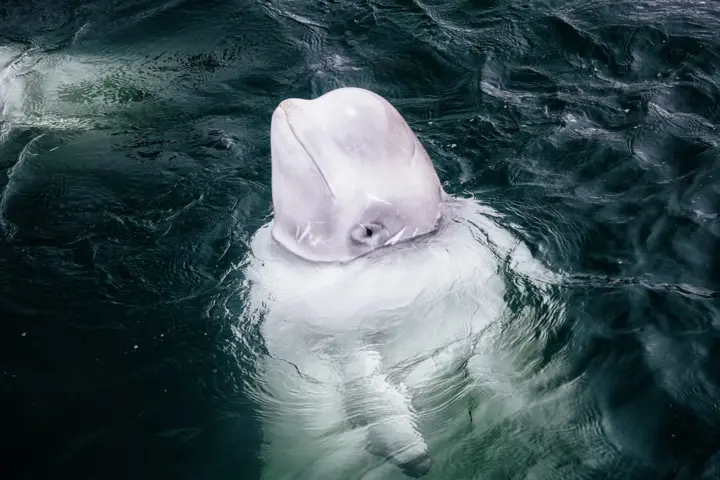
When we talk about the white whale, we mean a fascinating creature that holds many secrets and unique traits. The beluga is one of the most striking animals of the marine world and has several features that set it apart from other whales.
First, the white whale appears pure white, which makes it easy to distinguish from other species. This pale color results from a lack of melanin pigment in the skin, making it noticeably different from darker whales.
Second, beluga whales can reach substantial size. They can measure around 2 meters long and weigh about 1.5 tons. This size draws the attention of researchers and animal lovers worldwide.
Third, belugas are physically robust and capable of spending long periods underwater. They can dive to depths of up to 600 meters and remain submerged for more than 90 minutes. This ability helps them find food and evade danger.
Fourth, white whales are among the ocean’s most intelligent creatures. They possess advanced cognitive abilities that allow them to understand complex situations and to communicate with group members. They also use a rich range of sounds and echolocation to explore and interact.
The beluga is not just an ordinary marine creature but a special animal that continually fascinates us with its secrets and distinctive traits. Exploring these features broadens our understanding of marine life and its remarkable beauty.
3. Famous story: Moby Dick and the White Whale.
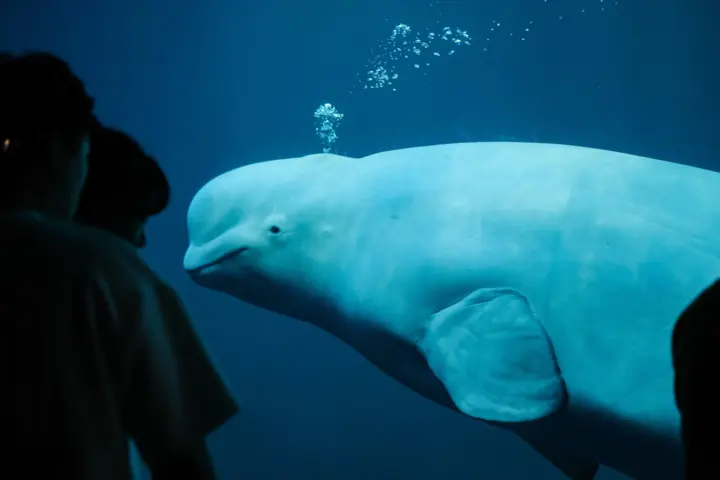
When the French explorer Jacques Cartier reached the Saint Lawrence River in 1535, beluga whales greeted his fleet. These belugas sang and danced in the water; their calls carried for hundreds of miles, and their sweet, clear voices amazed the crew, who affectionately nicknamed the white whales the "canaries of the sea."
According to reports from 2012, a white whale held by the National Marine Mammal Foundation in San Diego, California, had been imitating human speech for several years, producing sounds that resembled human voices and even repeatedly "talking" to underwater divers. One diver was reportedly fooled into thinking a human colleague was speaking to him. Scientists at the National Marine Mammal Foundation used underwater equipment to trace the source of the sounds and discovered they came from a beluga whale named Nock. Nock deliberately imitated human voices, apparently in an effort to communicate with people.
4. Curious facts about white whale that you may not know.
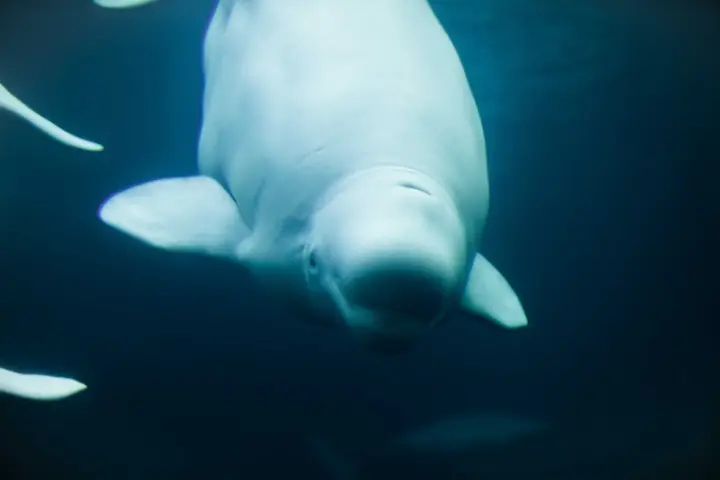
Beluga whales are found throughout the Arctic, with many living in waters off northern Europe, Alaska and Canada. They are highly social animals with complex group structures. Groups are often organized by age and sex; smaller units of mother and calf are also common. These groups spend the summer migrating south. Some populations migrate seasonally: those in the Bering Sea begin moving in early spring, reach coastal seas in summer, and head west again in autumn when temperatures fall and surface waters start to freeze.
Belugas feed on a variety of organisms, including fish, cephalopods, shrimp, crabs and larger plankton. They feed mostly near the seabed, sometimes at depths greater than 300 meters. Breeding times vary by region; mating usually occurs in spring and summer, with births the following summer. The average reproductive interval is about three years, and females typically bear a single calf.
Belugas often seem playful when they arrive at river mouths. Despite long migrations, they do not appear exhausted. In addition to constant vocal "conversations," they use their broad tail flukes to splash and play, sometimes lifting much of their bodies clear of the water in graceful poses. They also play with found objects: a piece of wood, a strand of seaweed or a stone can become a toy. They may carry a strip of seaweed, dive and float, making cheerful sounds; sometimes they become fixated on a basin-sized stone, turning it with their mouths, leaping with it, and even balancing the stone on their heads while performing at the surface.
White whales are also very clean. When several belugas first swim into an estuary delta, they may appear dirty, covered with parasites and old skin. They then dive and roll repeatedly in the river, rubbing against pebbles and shallow beaches. They repeat this behavior for hours each day. After a few days, the old skin peels off and new, bright white skin replaces it, giving the belugas a fresh, clean appearance.
5. White whale and marine environmental protection.
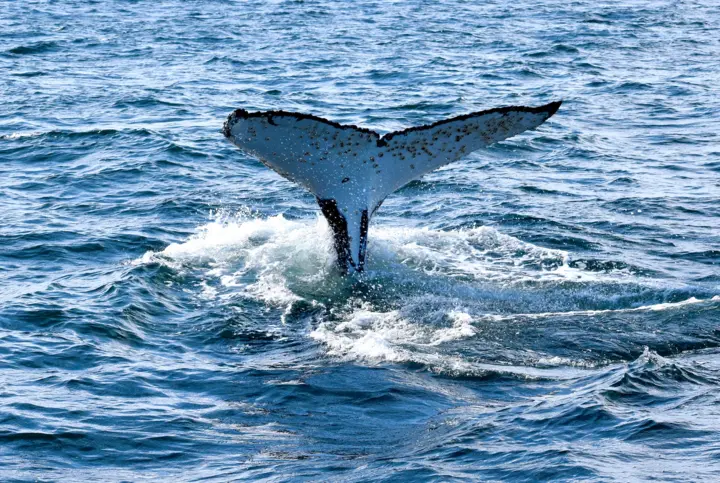
With growing threats to the marine environment, the white whale has become a symbol of protection for this vital ecosystem. This large animal highlights the importance of conserving the marine environment and maintaining the balance of its natural resources. Here are some ways white whales relate to marine protection and what we must do to safeguard this treasure.
Exploration of the marine environment:
Beluga whales live in cold oceans and play an important role in balancing those ecosystems. Tracking their movements helps scientists understand how they interact with other marine life and fisheries. Therefore, supporting scientific research and continuous monitoring of belugas is critical to protecting the marine environment.
The influence of environmental factors on beluga whales:
White whales are important indicators of ocean health and of the impacts of climate change and pollution. For example, ice loss in the Arctic has negatively affected beluga habitat and food sources, threatening their survival. We must monitor these factors and reduce their negative effects on belugas.
Human impact:
Beluga whales face threats from human activities such as hunting and pollution. Illegal commercial hunting for fur and oil has reduced some populations. To protect them, laws and regulations must be strengthened and enforced at both national and international levels.
Public awareness:
Educating the public about the need to protect belugas and the marine environment is essential. Awareness campaigns can explain the damage caused by marine pollution and other human activities and highlight the importance of conserving these animals and their habitats.
Global cooperation:
Environmental protection and beluga conservation are global issues requiring cooperation between countries. Nations should coordinate to develop international plans and agreements that safeguard these animals and their habitats for future generations.
Recognizing the importance of protecting belugas and the marine environment is key to ensuring life continues on Earth. We must work together as a global community to preserve these natural treasures and provide a better future for marine life and coming generations.
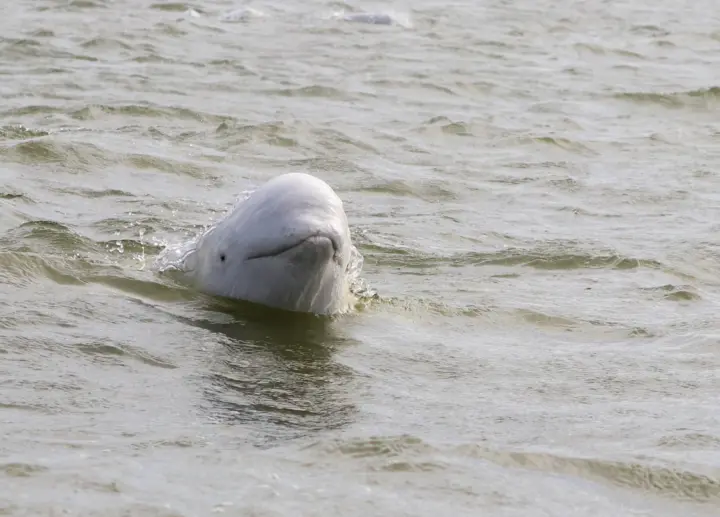
The white whale remains one of the most captivating and surprising creatures of the marine world. It reflects the beauty and resilience of nature and reminds us of the importance of protecting the ocean for future generations. Let us learn more about this extraordinary white whale and savor its special charm.